


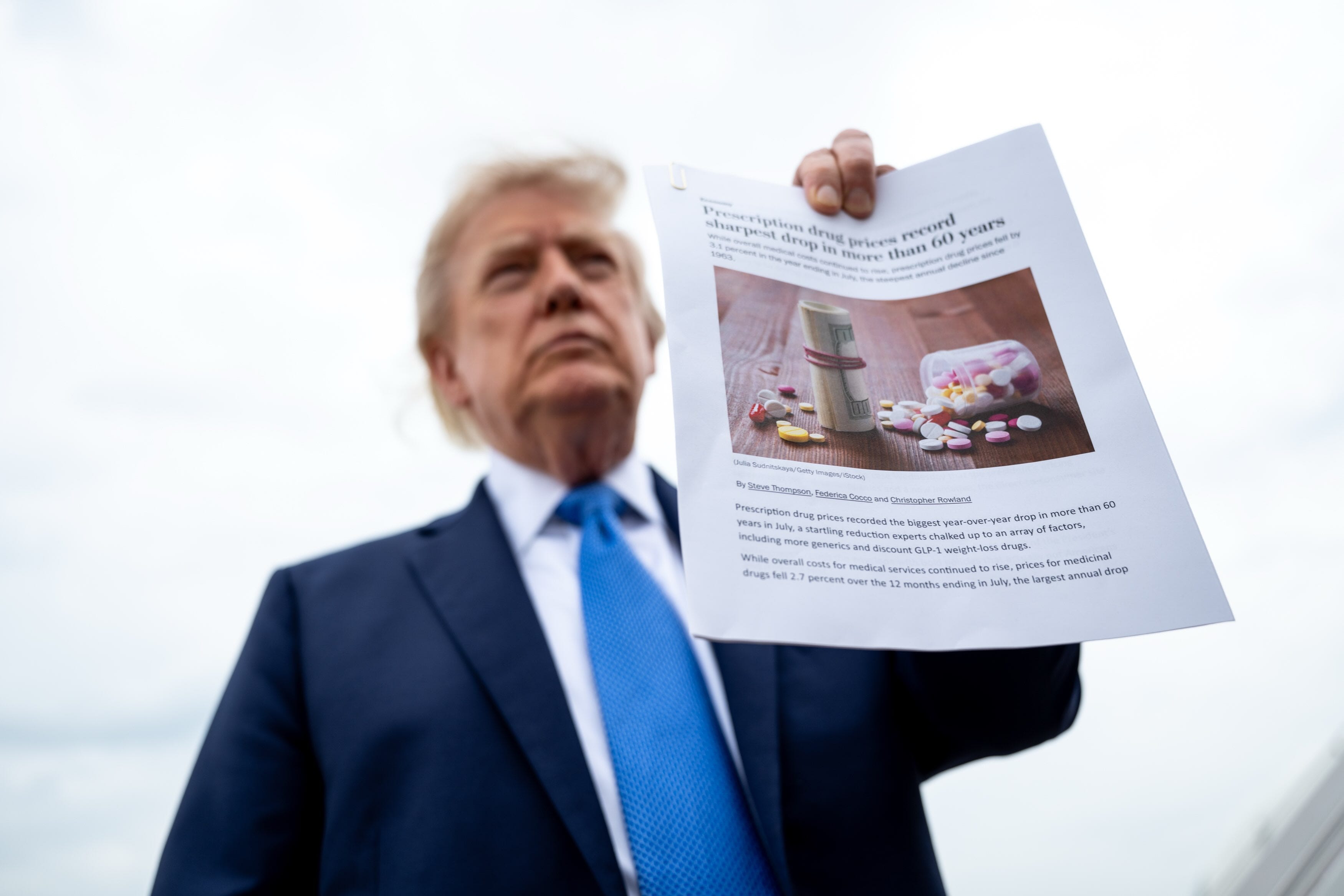
DONALD TRUMP presented reporters with a printed Washington Post headline on Friday that appeared to support one of his central claims about prescription drug prices. The report beneath it identified a policy signed by Joe Biden as the likeliest cause.
Trump held up the page, which showed the headline and the article’s opening five lines.
“The headline today is exactly that,” Trump said. “Did you see it?”
He read the headline aloud and raised the page again for the cameras. “It says, ‘Prescription drug prices record sharpest drop in more than 60 years,’” he said.
“OK, got it? Everybody have it?” He added: “And I told you that was going to happen.”
The Headline Becomes a White House Message
The White House circulated an image of the exchange across its official social-media accounts on Saturday. Its caption read: “POV: you bring the receipts.” Press secretary Karoline Leavitt also shared it.


The promotion had begun on Thursday, when White House communications director Steven Cheung posted a screenshot of the headline without linking to the article. “All thanks to President Trump!” he wrote.
Federal data confirmed the scale of the decline. The Consumer Price Index showed the prescription-drug index down 3.1% in July from a year earlier, its steepest annual fall since 1963.
The Washington Post article examined what had driven the change. It reported that the White House “took credit for” the fall. Experts quoted in the report said a “Biden-era policy that requires Medicare to negotiate prices for some popular prescription drugs is more likely to be driving down costs.”
Why Experts Point to Biden’s Medicare Law
The Inflation Reduction Act, signed by Biden in 2022, gave Medicare authority to negotiate the prices of selected high-cost medicines directly with manufacturers.
“The Inflation Reduction Act was a signature accomplishment of former president Joe Biden, a sprawling measure enacted in 2022 that aimed to lower prescription drug prices by requiring Medicare, the federal health program for the elderly, to begin negotiating the prices it pays drugmakers for an array of popular and costly prescription drugs,” the report said. “The first price reductions took effect at the beginning of this year.”
Only 10 drugs were included in the first round. They are commonly prescribed medicines, giving their negotiated prices enough weight to influence the broader index.
Richard Frank, a Harvard University professor emeritus of health economics, expressed doubt that Trump’s policies had produced the record decline.
Frank identified the Inflation Reduction Act as the leading explanation. “If I was a betting guy on what mattered most, it would be probably stuff around the Inflation Reduction Act,” he said.
Stacie Dusetzina, a Vanderbilt University health-policy professor, also identified the law signed by Biden as the likelier explanation. The negotiated medicines are widely used, she said, “and their prices would likely be reflected in the prescription drug index.”
Credit for a Consequential Decline
The falling index matters directly to people who rely on prescription medicines, particularly Medicare beneficiaries using drugs covered by the negotiations. It also affects federal spending and the political argument over which administration’s policies are lowering household costs.
The prescription-price index captures only one part of what Medicare enrollees pay. The Trump administration is also ending a $3.6 billion subsidy that restrained standalone Part D premiums, with millions projected to face increases in 2027.
Trump’s presentation removed that policy history from view. The White House distributed the headline as evidence of his record, leaving the article’s explanation outside the frame.
The next federal price reports will show whether the decline continues. They will also provide further evidence about the impact of Medicare negotiations as the first reduced prices work through the market.

A Quick Ask: Because Independent Journalism Does Not Fund Itself.
Press freedom does not survive on vibes. It survives because readers decide the work is worth protecting. The Developer is independent, ad-free, and reader-funded—which means your support goes directly into the reporting, not into some billionaire’s pocket. If my work helps you stay informed, consider upgrading to paid: $8/month or $80/year. If upgrading isn’t possible right now, sharing The Developer with someone who needs to read it matters just as much. Help keep independent journalism alive and impossible to buy.


Did he read the report or just take credit for the price drop? Thank you President Biden!
The lack of intelligence is not surprising, but they can throw out uneducated insults like a mother.