


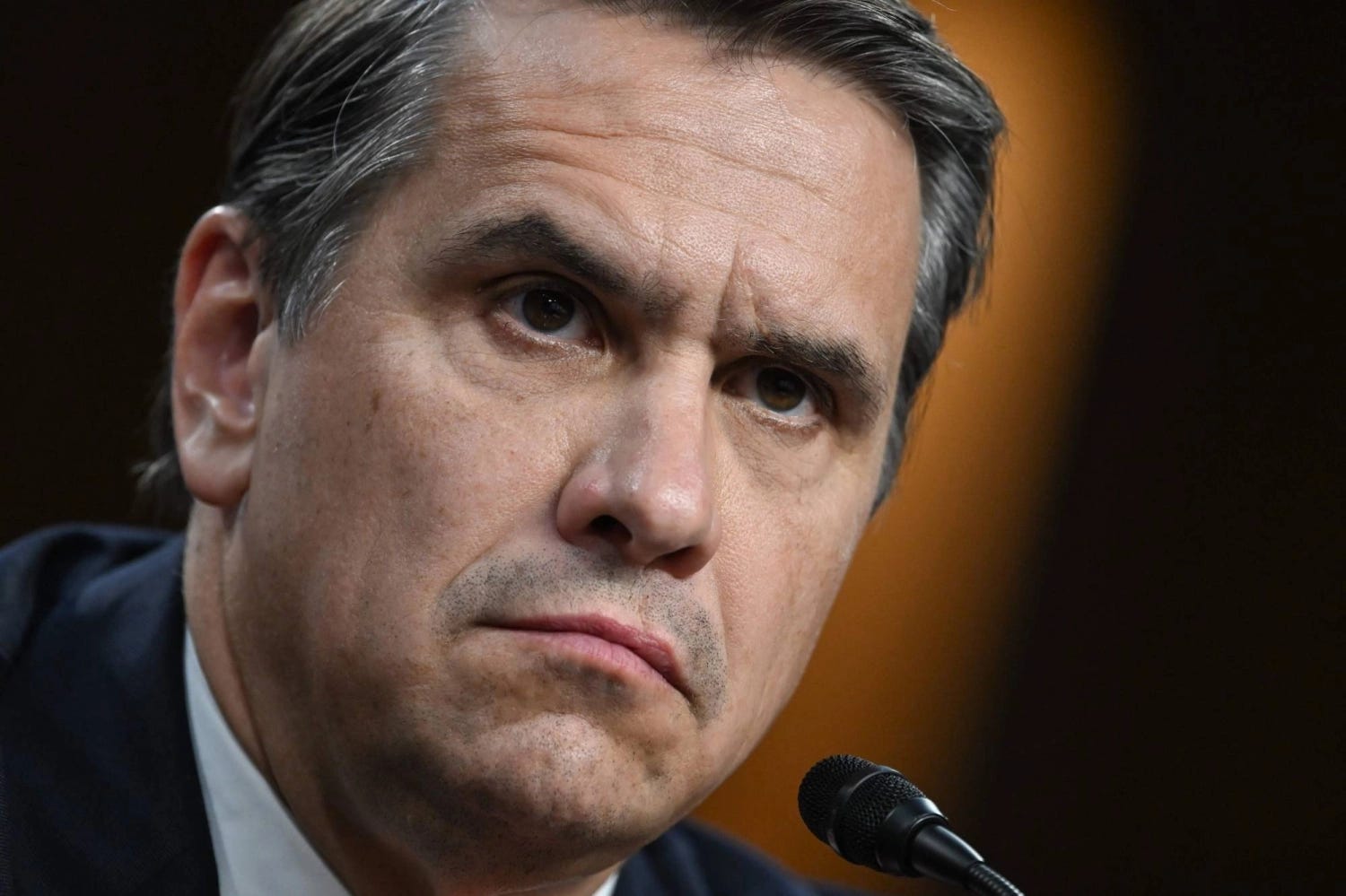
TODD BLANCHE declined Sunday to promise that the Justice Department would always act independently of the White House, placing his confidence in Donald Trump at the center of a dispute over political influence and impartial justice.
Asked by Kristen Welker on NBC’s Meet the Press whether he would make that commitment, Blanche gave an unequivocal answer.
“No, I’m not going to pledge that,” he said. “And no attorney general should ever pledge that.”
Blanche maintained that Trump would never ask him to cross an ethical or legal boundary.
“The president will never ask me to do something unethical or legal or illegal,” Blanche said.
“He never has. He never will. And no, I have—I swore to the constitution of the United States, like every cabinet secretary has done, and like every attorney general before me has done.”
He blamed concerns about presidential interference on Trump’s political opponents and the press.
“And so, this narrative that’s mostly pushed by the left and pushed by the media that the president’s going to pull me aside and ask me to do something illegal is completely a false narrative, not true, will not happen and hasn’t happened.”
The answer matters because Justice Department independence is a safeguard for the public, defendants and crime victims. It allows Americans to trust that investigations and prosecutions are driven by law and evidence, free from a president’s personal loyalties, resentments or political interests.
Blanche offered a different assurance. He asked the public to trust that Trump would never make an improper request and pointed to his own oath as protection against misconduct. His refusal to state that the department would act independently leaves the boundary between presidential wishes and federal law enforcement undefined.
Barbara McQuade, a University of Michigan law professor and former federal prosecutor, described Blanche’s position as “an appalling departure” from the Justice Department’s post-Watergate mission.
“The Justice Department, as we once knew it, is no more,” McQuade wrote.
“Blanche has turned it into Trump’s private law firm. What a complete disgrace.”
That criticism reflects the central concern surrounding Blanche: whether he has fully made the transition from representing Trump as a private client to serving the country as attorney general.
The Senate confirmed Blanche 50-49, with every Democratic senator voting against him. His confirmation placed Trump’s former criminal defense lawyer in permanent command of the department whose power includes investigating and prosecuting federal crimes.
Blanche represented Trump when a New York jury convicted him on 34 felony counts of falsifying business records connected to payments involving adult film actor Stormy Daniels. The representation established a close professional relationship that has continued to shadow Blanche’s government service.
The circumstances surrounding his elevation have intensified that scrutiny. Trump appointed Blanche after dismissing Pam Bondi, his previous attorney general. The president removed her after growing frustrated with her handling of the Justice Department’s release of files concerning dead pedophile Jeffrey Epstein and the department’s failure to secure cases against several of his perceived political enemies.
Blanche had already expressed striking personal loyalty to the president. In April, he said that if Trump chose to replace him, he would respond: “I love you, sir.”
That declaration gives added weight to his refusal to guarantee institutional independence. Blanche’s defense rests on his judgment of Trump’s character and intentions. The controversy concerns whether the nation’s chief law enforcement officer can separate that personal faith from his responsibility to administer justice impartially.
Blanche’s handling of the Epstein files has created another test of that responsibility. He defended the transfer of Ghislaine Maxwell, Epstein’s associate and a convicted child sex trafficker, to a minimum-security prison. He has also faced scrutiny over his treatment of people abused through Epstein’s sex-trafficking network, including criticism that one meeting with survivors amounted to a “performative move.”
Blanche also defended Trump’s pardoning of approximately 1,500 supporters convicted of attacking the U.S. Capitol in January 2021. The pardons covered more than 170 people who pleaded guilty to assaulting police officers.
“I’m not opining or in any way saying what President Trump did was wrong,” Blanche said.
“That is the president’s right.”
Welker also asked whether any of the pardoned attackers could receive settlements from the federal government. Blanche declined to rule out that possibility. He separately claimed that a proposed $1.8 billion “anti-weaponization” fund for Trump allies who considered themselves unfairly prosecuted was dead.
“Well, anybody can file a claim against the federal government, not just anybody associated with [the Capitol attack],” Blanche said.
“I’m not going to sit here and say on a news program whether a litigation that may or may not happen will result in money. I can’t do that.”
The possibility of government settlements extends the significance of the pardons. Clemency erased or reduced criminal consequences for Trump supporters. Federal compensation could provide them with a financial recovery based on claims that their prosecutions were unjust.
Blanche also affirmed that the Justice Department would continue its “election integrity” efforts. The department has suffered more than 20 consecutive court defeats in cases seeking to force states to provide voter rolls ahead of the November midterm elections.
The legal campaign is continuing as Trump’s Republican Party is projected to lose seats in Congress and favored to lose its House majority. Blanche’s commitment keeps the Justice Department involved in election-related litigation during a campaign with direct consequences for the president’s power.
His Sunday interview brought the concerns surrounding his leadership into a single frame: a refusal to promise independence from the White House, a defense of clemency for Trump supporters, no categorical rejection of potential government payments to pardoned Capitol attackers and a commitment to continue unsuccessful voter-roll litigation before the midterms.
The stakes reach beyond one interview or one attorney general. A Justice Department perceived as an extension of a president’s personal interests loses the public confidence required to exercise its authority. Investigations of opponents can appear retaliatory. Favorable decisions involving allies can appear politically arranged. Election-related litigation can appear designed to serve the party controlling the White House.
Blanche says his oath and Trump’s restraint provide sufficient protection. His critics say independence must remain an explicit commitment of the office. Blanche has now declined to make that commitment.

A Quick Ask: Because Independent Journalism Does Not Fund Itself.
Press freedom does not survive on vibes. It survives because readers decide the work is worth protecting. The Developer is independent, ad-free, and reader-funded—which means your support goes directly into the reporting, not into some billionaire’s pocket. If my work helps you stay informed, consider upgrading to paid: $8/month or $80/year. If upgrading isn’t possible right now, sharing The Developer with someone who needs to read it matters just as much. Help keep independent journalism alive and impossible to buy.


Was there ever any doubt, he’s as corrupt and soulless as Trump
No shit. Everyone called it.