

EXPLAINER: Two Straits, One War—How the Houthi Blockade at Bab el-Mandeb Threatens to Seal Off the World's Oil
Houthi strikes on Saudi tankers open a second front at Bab el-Mandeb, pairing with Iran's near-shut Strait of Hormuz to squeeze the world's crude and drive oil past $100 a barrel.

Summary:
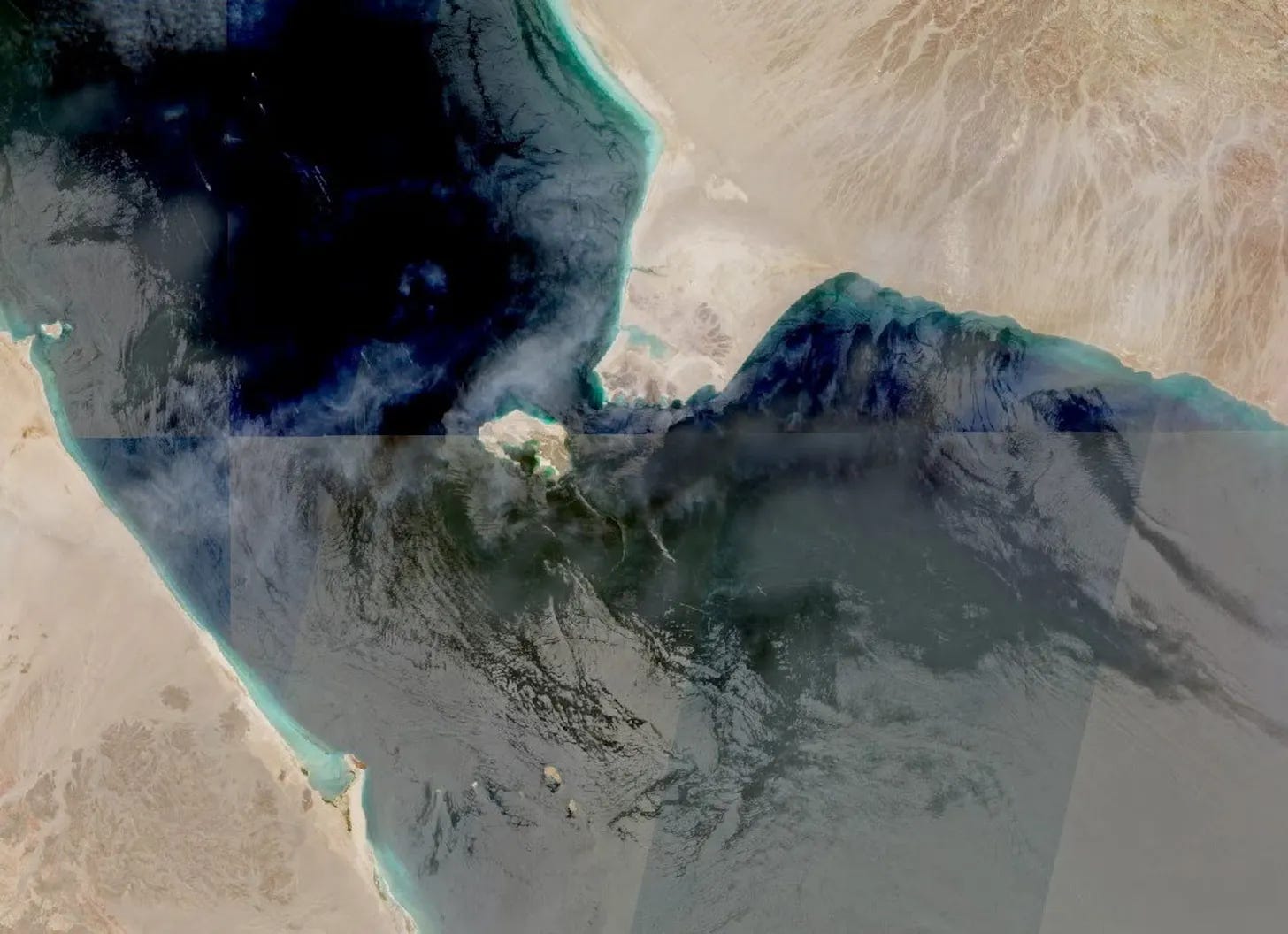
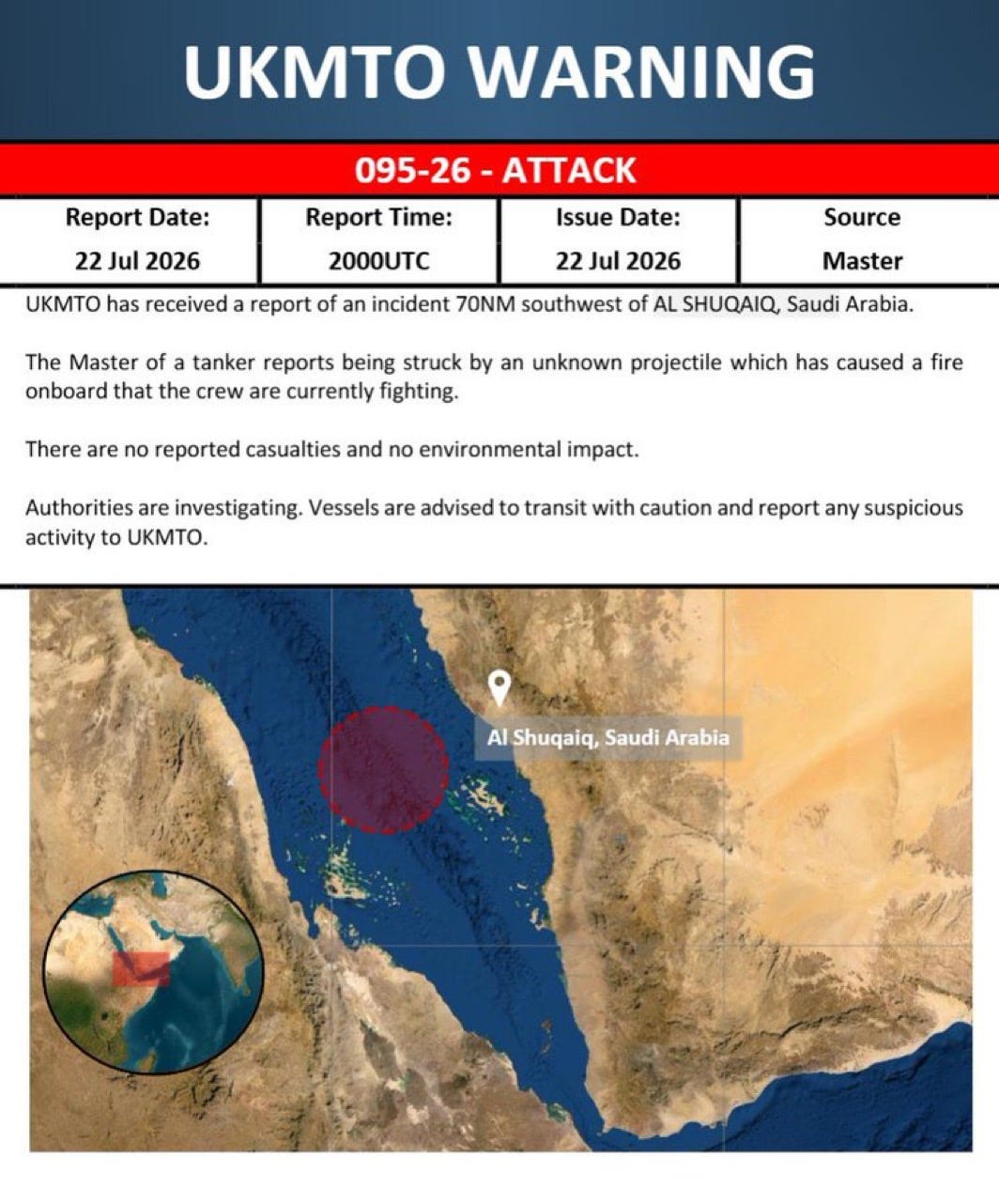
Yemen’s Houthi militants say they struck two Saudi oil tankers with drones and missiles in the Red Sea, enforcing a naval blockade on Saudi Arabia declared Monday.
The attacks create the specter of a second chokepoint on global oil supplies alongside Iran’s near-closure of the Strait of Hormuz.
Brent crude crossed $100 a barrel for the first time since May, rising more than 6%.
U.S. forces completed a 12th consecutive night of strikes on Iran; Iran answered with attacks on U.S. positions in Jordan and Kuwait.
Iran flew IRGC commanders, missile- and drone-related equipment and gold into Yemen on July 13, four sources told Reuters.
Two Chinese supertankers carrying 4 million barrels of Saudi crude are steaming toward the strait—the blockade’s first real test.
President Donald Trump warned of “major military punishment” against Iran and the Houthis if the attacks continue.
YEMEN’S Iranian-allied Houthi militants said Thursday they struck two Saudi oil tankers with drones and missiles in the Red Sea, the first blows delivered under a naval blockade against Saudi Arabia the group declared on Monday. Within hours, Brent crude surged past $100 a barrel for the first time since May.
🎥 Footage shows the aftermath of a Houthi strike, with a Saudi oil tanker engulfed in flames in the Red Sea. Source: Open Source Intelligence (OSINT).
The strikes drag the Red Sea into a war that has already choked the world’s most important oil artery. With Iran holding the Strait of Hormuz near closure and American warplanes hitting Iranian targets for a 12th consecutive night, the Houthi campaign threatens to slam shut a second chokepoint on global oil supplies—the Bab el-Mandeb strait at the Red Sea’s southern gate. Two chokepoints closed at once would leave the bulk of Gulf crude with no direct sea route to the customers who burn it.
Why the Bab el-Mandeb Matters
The Bab el-Mandeb—Arabic for “Gate of Tears”—separates Yemen from Africa and funnels all shipping between the Red Sea, the Suez Canal and the Indian Ocean. It is 18 miles wide at its narrowest point, squeezing tankers into two channels just 2 miles wide each. Roughly 9% of all seaborne-traded petroleum moves through it in normal times.
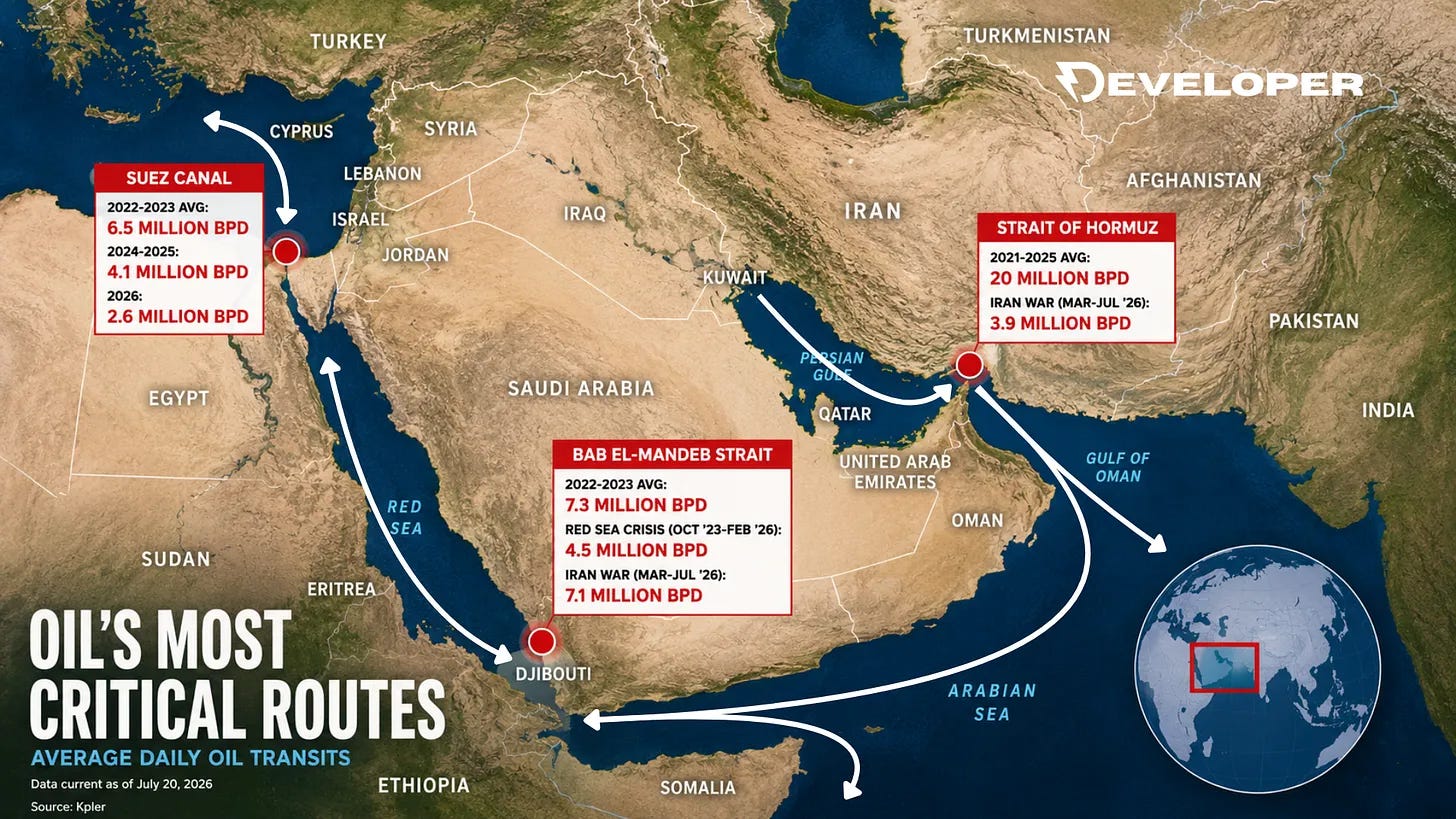
Those were normal times. Since Iran’s near-closure of Hormuz—the passage that ordinarily carries about one-fifth of the world’s oil consumption—the Red Sea has carried far more of the load, and the Bab el-Mandeb has become the single most consequential stretch of water in the global energy trade after Hormuz itself.
How Saudi Arabia’s Workaround Became a Target
When Hormuz was largely blocked, Saudi Arabia rerouted its exports westward. The kingdom pushed its East-West pipeline to a record 7 million barrels per day, turning the Red Sea port of Yanbu into its primary crude outlet. Yanbu’s route to Asia—the kingdom’s main market—runs straight through the Bab el-Mandeb.
The Houthi blockade converts that lifeline into a shooting gallery. Saudi crude loadings have already dropped 36% since the threats began. Many vessels carrying Saudi crude to Asia are changing course away from the strait entirely, sailing north through the Suez Canal into the Mediterranean and then circumnavigating Africa—adding weeks and enormous cost to every cargo. Enforcing safe passage would fall to a U.S. military already stretched across two fronts of the same war.
The Blockade’s First Test: Two Chinese Supertankers
The confrontation now has a clear flashpoint. Two Chinese very large crude carriers, loaded with a combined 4 million barrels of Saudi Arabian oil, are heading toward the Bab el-Mandeb strait. Their transit will show how tightly the Houthis intend to enforce the blockade—and whether cargoes bound for China, Iran’s most important economic partner, get a pass.
The group has done this before. Between late 2023 and 2025, the Houthis attacked well over 100 vessels transiting the Red Sea, sinking several and killing seafarers, before pulling back from the campaign in late 2025. They stayed on the sidelines through the first weeks of the U.S.-Iran war. That restraint ended Thursday.
Twelve Nights of American Strikes
At 10:30 p.m. ET on July 22, U.S. Central Command completed another round of strikes against Iran—the 12th consecutive night of attacks ordered by Trump. American forces hit Iranian maritime capabilities, missile and drone storage facilities, coastal surveillance sites and air defense assets, strikes CENTCOM says further degrade Iran’s ability to attack civilian mariners and commercial vessels.
The campaign extends to the water. U.S. forces have targeted dozens of Iranian military sites on land this month while resuming a blockade against Iran at sea, redirecting nine commercial vessels and disabling one to keep ships from entering or departing Iranian ports. More than 50,000 U.S. service members are operating across the Middle East.
Iran hit back. Tehran said it attacked U.S. missile systems, weapons and fuel storages in Jordan, along with U.S. military posts in Kuwait including Al-Adiri Camp, Ali Al Salem Air Base, Doha Camp and Arifjan Camp.
Iran’s Hand in Yemen
The Houthi entry into the war followed direct Iranian reinforcement. Iran flew Islamic Revolutionary Guard Corps commanders, military advisers and missile- and drone-related equipment into Yemen this month, four sources familiar with the matter told Reuters, including two Iranian sources, Yemen’s information minister and a regional security analyst.
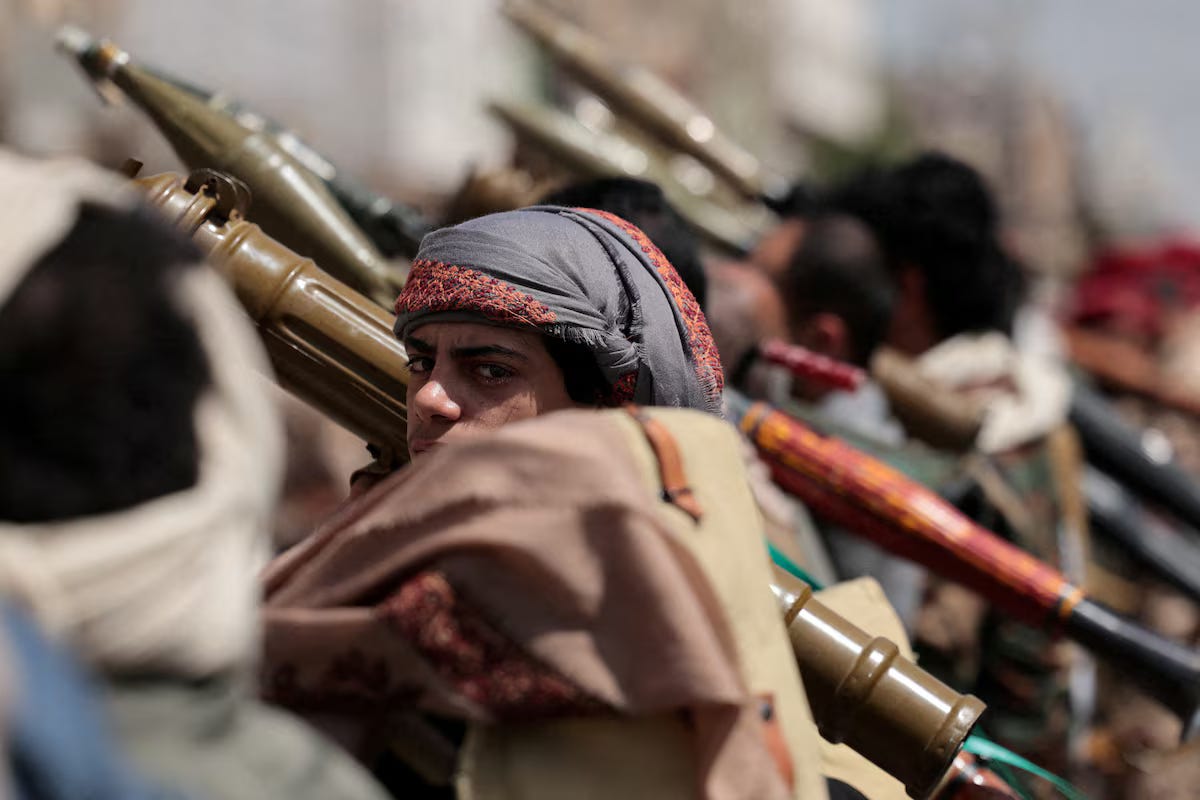
Between 10 and 21 IRGC personnel, including senior commanders, traveled on a Mahan Air flight from Tehran on July 13—the airline has been under U.S. sanctions since 2011 for ferrying IRGC personnel and weapons. The plane was bound for the Houthi-controlled capital Sanaa and diverted to the Red Sea port of Hodeidah after Sanaa’s airport came under attack by the Saudi-backed Yemeni government. The commanders came to support Houthi operations and provide training on new missile systems, one source said. The aircraft also carried gold to fund Houthi activities.
Washington Draws a Red Line
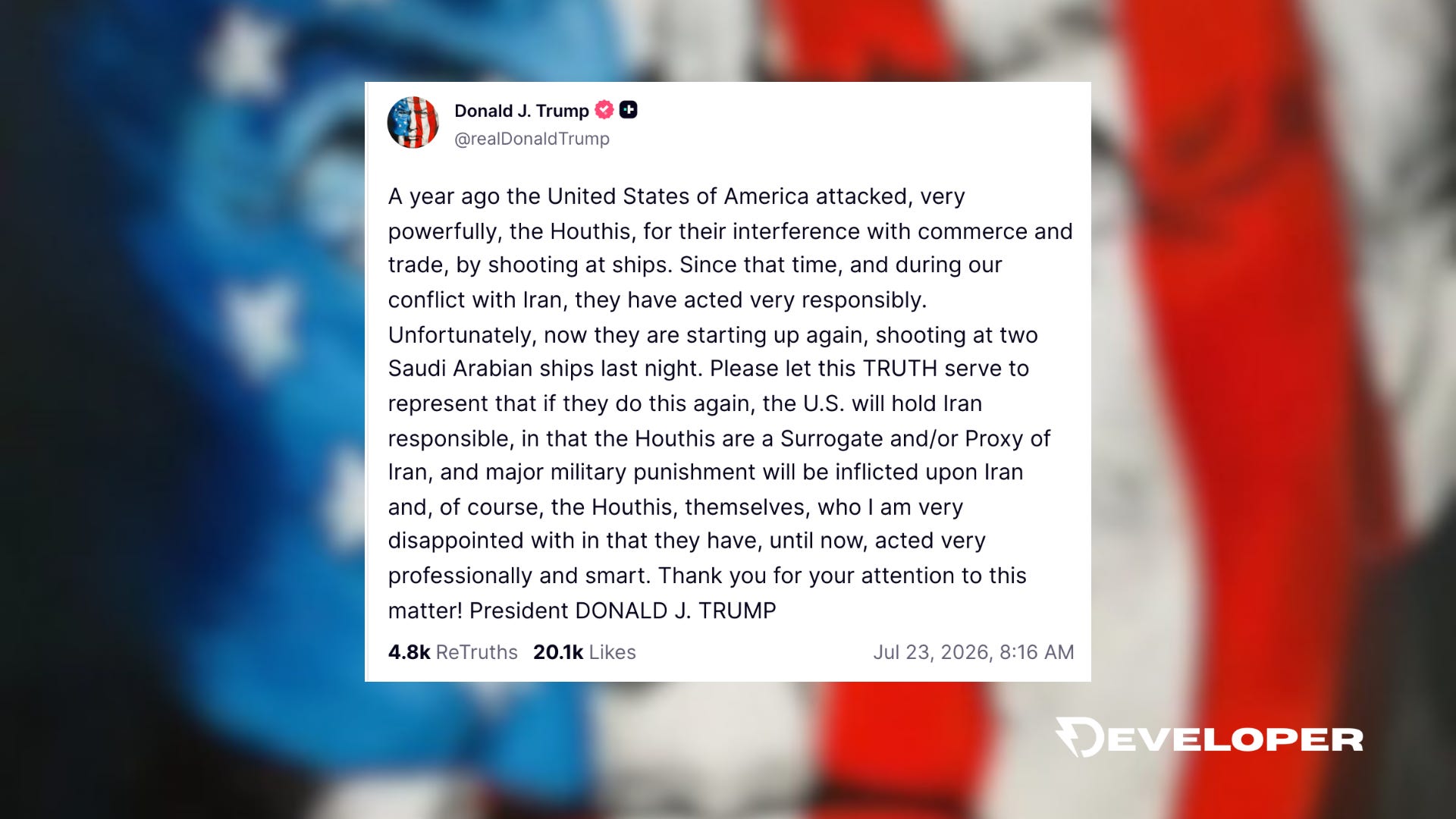
Trump made the consequences explicit. In a Truth Social post, he said the United States would hold Iran responsible for Houthi attacks, calling the group “a Surrogate and/or Proxy of Iran” and promising that “major military punishment will be inflicted upon Iran and, of course, the Houthis, themselves” if the strikes recur.
Secretary of State Marco Rubio, speaking at an ASEAN security forum in the Philippines, said the Houthis “got suckered into this by the Iranians” after staying out of the conflict for weeks, and urged them to stop. On Iran, Rubio said Tehran makes deals and breaks them “almost immediately,” and would continue to “pay the price”—a price “getting higher every night.” He said Washington’s goal remains a denuclearized Iran, and that any further U.S. escalation is “the president’s decision to make.”
What It Means for Oil—and Everyone Who Buys It
The market delivered its verdict in hours: Brent jumped more than 6% past $100, its highest level since May. Each closed chokepoint compounds the other—crude that detoured around Hormuz now faces a gauntlet at Bab el-Mandeb, and every rerouted cargo adds cost that flows through to fuel, freight and food prices worldwide. An economy already absorbing one supply shock may respond to a second by slowing down.
The producers are the exception. TotalEnergies said second-quarter net profit doubled to $5.4 billion as the war pushed up fuel prices. Norway’s Equinor, the UK’s biggest gas supplier, nearly doubled its quarterly profit to $11.5 billion after raising output to fill the gap left by slumping Gulf flows, with Brent reaching $95 a barrel even before Thursday’s attacks. The climate group Uplift accused Equinor of “raking in billions in profits while millions of people across the UK are struggling with unaffordable energy bills.”
What to Watch
The two Chinese supertankers’ run at the Bab el-Mandeb will reveal whether the blockade is total or selective. Trump’s warning sets a tripwire: another Houthi strike invites U.S. retaliation against both Yemen and Iran, widening a war already fought across two fronts. And the oil market will price every hour of uncertainty—with both of the world’s critical crude chokepoints now contested, $100 oil is the floor the market is testing, not the ceiling.
A Quick Ask: Because Independent Journalism Does Not Fund Itself.
Press freedom does not survive on vibes. It survives because readers decide the work is worth protecting. The Developer is independent, ad-free, and reader-funded—which means your support goes directly into the reporting, not into some billionaire’s pocket, corporate boardroom, or cowardly institution waiting for permission to fold. If my work helps you stay informed, consider upgrading to paid: $8/month or $80/year. If upgrading isn’t possible right now, sharing The Developer with someone who needs to read it matters just as much. Help keep independent journalism alive, loud, and impossible to buy.


Thank you ever so much Donny, your reporting is so vital for us.
And just think, this complete disaster was never necessary in the first place. Thank you all for the fight against this illegal war! And that is what it is.